With the devastating news about Tahlequah and Scarlet this summer, I found myself longing for a time when their struggles were not a common theme. I reflected on a time when I was a young boy and my grandfather took me out to his sailboat to see a pod of orcas in the San Juan Islands and was blown away by these majestic creatures. This memorable moment gave me great respect for the natural environment and a big reason why I’ve dedicated my life empowering people to become caretakers of the environment and our native wildlife. Our Southern Resident Killer Whale population have been in the national spotlight and it hasn’t been good news with no new calves born in the last three years. There are many factors for the decline in the 30-year low population relating to pollution, habitat, food supply, etc., and Stewardship Partners directly worked to solve these.
Orcas rely heavily on Chinook salmon, another endangered species, making our work to restore habitat and keep our waters clean one of the most important actions we can do to help orcas. It’s clear that we are at a critical time for our Southern Resident orcas, and we urge you to take action to protect and restore habitat. Become a Stewardship Partner today by donating, volunteering, or learning what actions you can do in your daily lives. It’s my hope that I can show my grandkids orcas in the Puget Sound one day.
Stories of Region-Wide Environmental Success
Tuesday, 19 March, 2019 13:30Written by Stewardship Partners
Great ideas often start with conversations. So many environmental stewards (including Stewardship Partners), community groups, conservation districts and environmental government programs are working hard to protect and restore the ecosystems that make this place special, yet we rarely hear about all the positive impacts of that work.
However, the time has come to start celebrating the work being done and raising awareness of projects big and small. To recruit and empower all our friends and neighbors to become stewards, we need to show them that positive change through stewardship is possible, these projects are working, and they will be duly rewarded for joining the stewardship ranks.
Stewardship is dispersed across the region and is carried out by a lot of hands, working on many different projects all towards a clear and collective goal of a healthier Puget Sound. In an effort to see where we are at in reaching this collective goal, Stewardship Partners created Sound Impacts (SoundImpacts.org). After surveying dozens of partners in stewardship about what would make an impact metrics portal enticing enough to actually use, the Stewardship Partners team hired CAI (a Seattle-based impact evaluation and technology firm) to help us create and launch Sound Impacts as an easy-to-use, visually impactful, transparent, and robust tool. Version 1.0 has been online for over a year now and the result is truly transformational.
Today on SoundImpacts.org you can create a user profile, measure your positive environmental impact, and start inspiring others to join in the movement to not just protect, but actually improve the environmental health and resiliency of our region. We know this is a large feat, but we also know it can be done. With over 4,000 rain garden projects and 89 permeable pavement projects currently registered, we know that our region’s stewards are already keeping over 70 Million gallons of harmful polluted runoff out of Puget Sound. But that is only the tip of the iceberg. With project types including tree plantings, invasive plant removal, depaving, and green roofs recently added, this tool is ready and waiting for many of our fellow stewards across the region to contribute their projects and watch the impacts skyrocket.
As we begin to make plans for upgrading Sound Impacts to a 2.0 version, we will add impacts beyond stormwater managed to include the many co-benefits of nature-based efforts like carbon sequestration, air quality impacts, urban heat island impacts, and community health impacts.
Are you ready to start telling your stewardship story? Look to see if the projects you have worked on have been registered on Sound Impacts and add them if they aren’t there yet! We know our region has a lot of stewardship heroes out there and we want to help tell the story of their work, so we can continue to inspire more individuals and communities to engage in acts of stewardship, building a movement to help leave this place better than we found it.
Cistern Maintenance
Friday, 24 August, 2018 11:38Written by Stewardship Partners
August is the time to make sure your cistern is in good working order and ready for the fall rainy season! RainWisehas outline five steps you can take to clean out your cistern to prepare it for fall.
By now, you have probably heard that stormwater runoff is a looming threat to our Puget Sound. But the good news is that there are ways we can slow down and filter stormwater runoff, preventing pollutants from making it into our precious bodies of water. This video created by Sightline Institute features our very own Aaron Clark speaking about green infrastructure solutions to polluted stormwater runoff.
Breaking Barriers for GSI Projects
Tuesday, 08 May, 2018 10:30Written by Stewardship Partners
Here at Stewardship Partners we do our best to help get as many green stormwater infrastructure (GSI) projects in the ground as possible. Unfortunately, while most landowners love the idea of a beautiful rain garden or cistern going in their yard, there are barriers to getting these projects installed. Many great incentive programs exist for installing GSI, like RainWise Rebates, but cost continues to be one of the biggest barriers landowners face.
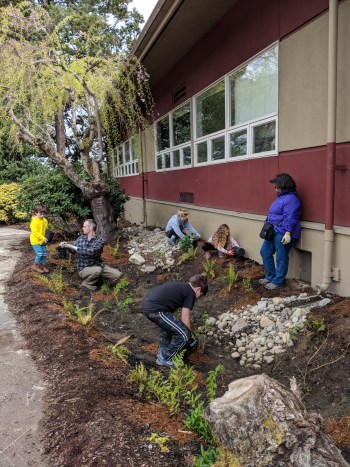
Newly installed rain garden getting its finishing touches.
We are working hard to address this issue by creating new incentive programs and expanding the financial assistance offered through the RainWise Program. Our recently launched GSI Mini Grants offer up to an additional $1,500 for landowners within the King County Wastewater Treatment Division (WTD) service area that are not eligible for other incentive programs. The goal of the GSI Mini Grant is to help provide both guidance and financial assistance for communities that are in areas of ineligibility for other incentive programs and may otherwise be unable to install GSI projects. Our RainWise Access Grants help income-limited and underserved communities by providing an additional $1,000 for RainWise eligible homeowners and nonprofit community organizations, bridging the gap between the RainWise rebate amount and actual project costs. Without this tool, even relatively small out of pocket costs for GSI projects could pose a barrier to landowners otherwise ready to install GSI on their property.
The creation of these tools comes from actively listening to and discussing with key partners like and community members. With a little out of the box thinking, the Stewardship Partners team was able to create a whole organizational infrastructure that didn’t exist before, all because we listened to communities sharing their experiences and barriers with us. After many tweaks and improvements to both of these tools, we now have Mini Grants and Access Grants flying off the shelves. We have a great sense of pride and gratification knowing we are able to give communities a hand in their work to protect Puget Sound.
You can find out more about these financial tools and other incentive programs at www.12000raingardens.org.