Posts Tagged ‘Gray to Green’

Breaking Barriers for GSI Projects

Here at Stewardship Partners we do our best to help get as many green stormwater infrastructure (GSI) projects in the ground as possible. Unfortunately, while most landowners love the idea of a beautiful rain garden or cistern going in their yard, there are barriers to getting these projects installed. Many great incentive programs exist for installing GSI, like RainWise Rebates, but cost continues to be one of the biggest barriers landowners face.
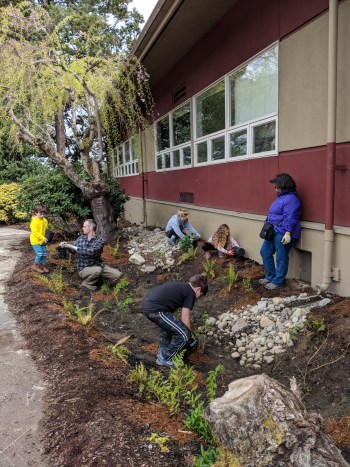
Newly installed rain garden getting its finishing touches.

We are working hard to address this issue by creating new incentive programs and expanding the financial assistance offered through the RainWise Program. Our recently launched GSI Mini Grants offer up to an additional $1,500 for landowners within the King County Wastewater Treatment Division (WTD) service area that are not eligible for other incentive programs. The goal of the GSI Mini Grant is to help provide both guidance and financial assistance for communities that are in areas of ineligibility for other incentive programs and may otherwise be unable to install GSI projects. Our RainWise Access Grants help income-limited and underserved communities by providing an additional $1,000 for RainWise eligible homeowners and nonprofit community organizations, bridging the gap between the RainWise rebate amount and actual project costs. Without this tool, even relatively small out of pocket costs for GSI projects could pose a barrier to landowners otherwise ready to install GSI on their property.

The creation of these tools comes from actively listening to and discussing with key partners like and community members. With a little out of the box thinking, the Stewardship Partners team was able to create a whole organizational infrastructure that didn’t exist before, all because we listened to communities sharing their experiences and barriers with us. After many tweaks and improvements to both of these tools, we now have Mini Grants and Access Grants flying off the shelves. We have a great sense of pride and gratification knowing we are able to give communities a hand in their work to protect Puget Sound.

You can find out more about these financial tools and other incentive programs at www.12000raingardens.org.

What’s Working & Who’s Missing?

Conversations of equity and youth pathways for green infrastructure

“I was shy, I was quiet, I would never be able to [speak to an audience like this]… Paulina gave me a voice… gave me a sense of purpose, gave me a safe place to do what I love to do which is to be an environmental activist for my community… in South Park and Georgetown.” These were the words of Daniella, a youth leader from the Duwamish Valley Youth Corps, speaking about her mentor, Paulina Lopez (who later received an award for youth mentorship from the City Habitats network). Voices and stories like Daniella’s took center stage at this year’s 3rd Annual Green Infrastructure Summit as we continued the quest to turn green infrastructure into a force for equity and environmental justice. A big part of that quest involves ensuring that as the green infrastructure sector grows, new jobs and career pathways are accessible and attractive to brilliant, diverse minds in communities disproportionately affected by pollution and environmental degradation.

On February 9th, Stewardship Partners reached another landmark in our leadership role of turning our region’s cities and towns from #GrayToGreen. As we convened the Puget Sound Green Infrastructure Summit, a City Habitats event, it was amazing to hear different perspectives from innovators across the region and sectors. Being mindful to “connect the dots” (.com, .org, .gov, and .edu), we are seeing more and more collaboration between public and private sectors, evident through the case studies and breakouts that day as well as research and implementation. The vision that inspired us to create this event in 2016 is beginning to turn into reality: the Puget Sound region is taking flight as a “Silicon Valley of Green Infrastructure.”

Photo credit: The Nature Conservancy/Courtney Baxter

As with the two previous summits, we intentionally centered and highlighted equity within the agenda and speakers throughout the day. The main theme of this year’s summit was green infrastructure jobs and youth pathways. With the understanding that host committee members and summit attendees are not youth in the community, we held a companion event, The Youth Forum on Green Infrastructure Jobs and Youth of Color, to ensure the youth voice was accurately represented. Held in January, this event brought together 20 young people of color together to discuss what they saw as barriers to entry into the green infrastructure field. This eye-opening discussion allowed us to bring new voices and faces into the conversation, informing workforce decision-makers who were in attendance at the summit.

To see the presentations, Youth Forum video, and other resources shared at the summit visit the summit webpage at: www.12000raingardens.org/summit

Green Infrastructure Summit: Next Generation Leaders

“I was shy, I was quiet, I would never be able to [speak to an audience like this]… Paulina gave me a voice… gave me a sense of purpose, gave me a safe place to do what I love to do which is to be an environmental activist for my community… in South Park and Georgetown.” These were the words of Daniella, a youth leader from the Duwamish Valley Youth Corps, speaking about her mentor, Paulina Lopez (who later received an award for youth mentorship from the City Habitats network). Voices and stories like Daniella’s took center stage at this year’s 3rd annual Green Infrastructure Summit as we continued a quest to make green infrastructure into a force for equity and environmental justice. A big part of that quest lies in making sure that as the Green Infrastructure sector grows, new jobs and career pathways become accessible and attractive to diverse and brilliant minds from communities disproportionately affected by pollution and environmental degradation.

On February 9th Stewardship Partners reached another landmark in our leadership role of turning our region’s cities and towns from #GrayToGreen. As we convened the Puget Sound Green Infrastructure Summit, a City Habitats event, it was amazing to see the difference this event makes for innovators across the region and sectors. As we continue to mindfully “connect the dots” (.com, .org, .gov, and .edu), we are seeing more and more collaboration between public and private sectors, as well as research and implementation. The vision that inspired us to create this event in 2016 is beginning to turn into reality: The Puget Sound region is taking flight as a “Silicon Valley of Green Infrastructure.”

As with both of the two previous summits, our cross-sector host committee (including Seattle Public Utilities, MIG|SvR, Washington State University, Salmon-Safe, Washington Environmental Council, and The Nature Conservancy) intentionally centered and highlighted equity within the agenda and speakers throughout the day. This year the main theme of the summit was green infrastructure jobs and youth pathways. A new companion event: The Youth Forum on Green Infrastructure Jobs and Youth of Color, held in January, allowed us to bring new voices and faces into the conversation, informing workforce decision-makers at the summit. The UW Bothell/Cascadia College campus (a Salmon-Safe certified campus) provided a powerful backdrop for the summit next to a created wetland and floodplain. Welcome remarks from Ken Workman, a direct descendant of Chief Seattle, Andy Rheaume, Bothell’s mayor, Anthony Guerrero of UW Bothell, and Aaron Clark, grounded the 220 attendees in time and place, ready to imagine and co-create our shared clean water and healthy community future. A few highlights from the day included: a keynote discussion on diversity in the green infrastructure field; an award for youth leadership given to Paulina Lopez of the Duwamish River Cleanup Coalition and the Duwamish Valley Youth Corps; a panel on pavement and it’s immense impacts on water, habitat, and pollution; breakout sessions on trees, codes and policies, maps, mentorship and equity, and research gaps; case studies throughout the day; and calls to action from Washington State Representative Derek Stanford and Steve Shestag from Boeing.

Like everything Stewardship Partners does, this accomplishment was a team effort. It included the entire SP staff, an immense community of partners (especially those from the City Habitats network), the host committee, and of course the generous sponsors who, at 13 financial sponsors, have more than doubled our sponsor base from the first summit we convened in 2016. To see the presentations, videos and other resources shared at the summit visit the summit webpage at: www.12000raingardens.org/summit

Puget Sound Green Infrastructure Summit was a Great Success!

Last Thursday, February 24th, over 180 thought leaders from government, business, academia and the non-profit sector gathered at the Mountaineers for the inaugural Puget Sound Green Infrastructure Summit. The idea behind this first-of-its-kind gathering started as brainchild of our 12,000 Rain Gardens Program Manager, Aaron Clark, but the resulting event was thanks to the hard work of our host committee and event sponsors. Our overarching question was simple, but vast.

How can we work together to incorporate green stormwater infrastructure (GSI) into the gray of our cities? 

GSI includes tools and strategies that help our cities mimic the natural functions of the forests that used to cover our region.

This is important for many reasons; the primary being that polluted runoff from hardened surfaces – roads, traditional pavement and compacted soils – is, according to the Washington State Department of Ecology, the biggest polluter of our Puget Sound. Bringing green into the gray also helps mitigate the impacts of climate change, improves property values and creates wildlife habitat.  A recent report by the Nature Conservancy of Washington shows that human health and our ability to concentrate and manage stress is directly tied to our access to green places.

Puget Sound Green Infrastructure Leaders

Puget Sound Green Infrastructure Leaders

Throughout the day’s many presentations and workshops it was clear that people were thirsty to collaborate and work across sectors.  It was apparent that challenges exist, but the overall energy was optimistic. We were able to talk through the strengths and weaknesses of each sector as we identified new perspectives and different opportunities to collaborate.

The event take-aways include:

1.      Our urban water challenges are big (see infographic).  They are  bigger than we have the resources to deal with in government  or through regulation. Private sector funding and innovation are needed.

2.      We are exploring new territory – Nobody has figured this out.  Anywhere.  But urban water quality is a problem across the country and we in the northwest have a history of innovation and commitment to environmental responsibility that sets us up to be solutions leaders.

3.      Design-thinking is going to be a critical part of this problem-solving process as we attempt to work through a watershed-wide approach. The design industry has a problem solving mindset that will be critical to success in cross-sector discussions, coupled with the ability to provide on-the–ground experience and feedback about projects that are working and those that are not.

4.     There is a common perception that Puget Sound is not in trouble, but that it is getting cleaner – we need to do a better job of presenting the facts and solutions. We must articulate ways to, “prevent pollution of Puget Sound,” instead of talking about ways to, “clean up Puget Sound”.

5.      Our GSI challenges can become “green collar” job and we heard about ideas that marry our goals for natural infrastructure with affordable housing. Nature helps all of us.

6.      We need to adopt a “patient urgency” to aggressively accelerate this work as we coordinate and listen so we can bring a more varied group of interests into the fold and we move forward.

We are in the process of analyzing the comments and feedback from the summit and will be sharing our findings and next steps soon! 

Learn More: Event photos  Everett Herald Editorial #GraytoGreen #BoeingPartner

A big thank you to our Host Committee, Sponsors and all who participated!

The Nature Conservancy in Washington, Washington Environmental Council, MIG SvR, Seattle.Gov, Washington State University, Boeing Company, The Russel Family Foundation, Cascadia Consulting Group, King County, WTD, Hitchcock Delicatessen & Charcuterie, Caffe Vita, Hilliard’s Beer, Salmon-Safe