Posts Tagged ‘rain garden’

Breaking Barriers for GSI Projects

Here at Stewardship Partners we do our best to help get as many green stormwater infrastructure (GSI) projects in the ground as possible. Unfortunately, while most landowners love the idea of a beautiful rain garden or cistern going in their yard, there are barriers to getting these projects installed. Many great incentive programs exist for installing GSI, like RainWise Rebates, but cost continues to be one of the biggest barriers landowners face.
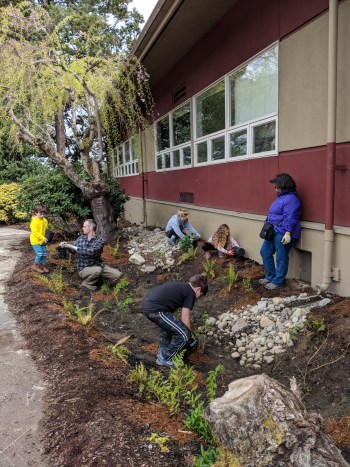
Newly installed rain garden getting its finishing touches.

We are working hard to address this issue by creating new incentive programs and expanding the financial assistance offered through the RainWise Program. Our recently launched GSI Mini Grants offer up to an additional $1,500 for landowners within the King County Wastewater Treatment Division (WTD) service area that are not eligible for other incentive programs. The goal of the GSI Mini Grant is to help provide both guidance and financial assistance for communities that are in areas of ineligibility for other incentive programs and may otherwise be unable to install GSI projects. Our RainWise Access Grants help income-limited and underserved communities by providing an additional $1,000 for RainWise eligible homeowners and nonprofit community organizations, bridging the gap between the RainWise rebate amount and actual project costs. Without this tool, even relatively small out of pocket costs for GSI projects could pose a barrier to landowners otherwise ready to install GSI on their property.

The creation of these tools comes from actively listening to and discussing with key partners like and community members. With a little out of the box thinking, the Stewardship Partners team was able to create a whole organizational infrastructure that didn’t exist before, all because we listened to communities sharing their experiences and barriers with us. After many tweaks and improvements to both of these tools, we now have Mini Grants and Access Grants flying off the shelves. We have a great sense of pride and gratification knowing we are able to give communities a hand in their work to protect Puget Sound.

You can find out more about these financial tools and other incentive programs at www.12000raingardens.org.

Time for Summer Rain Garden Maintenance

Summer is here, which means it’s time to water your rain garden! 

During the first two years of your rain garden’s life the plants are just getting established and will need water during dry periods. Once the roots have spread out and down (after two years) you won’t need to water them as much or at all.

If your rain garden is less than 2-3 years old, now is the time to start watering it!

RainWise has produced a video on “Watering Rain Gardens” that can help you learn how much to water your rain garden.

You can also refer to the Rain Garden Care Guide for helpful tips on watering and general plant care (Watering, page 10).

We have many great rain garden resources available in our Resource Library to answer your rain garden questions and help you maintain your hardworking garden!

Please feel free to contact us if you have any questions!

Rain Garden Planter Project Guide

The finished project!

As some of you may remember, back in October 12,000 Rain Gardens and the Seattle Garden Club worked together to install a planter rain garden in the Laurelhurst neighborhood.  A galvanized water trough was turned into a rain garden which would capture run off from roughly 200 sq. feet of contributing area. While the planter rain garden turned out to be a beautiful addition to the homeowner’s yard, the original methods we used to put together the rain garden were not successful. The homeowner experienced issues with the rain garden’s functionality and drainage.

We recently revisited the site and made some changes to the planter rain garden in order to get it to manage stormwater properly. Through this process of installing and then re-designing the rain garden, we learned a lot about how to successfully put together a planter rain garden. We have put together a document which explores this process and shares the steps that were used to create this planter rain garden. We hope that our Rain Garden Planter Project Guide will be useful to others who are interested in designing and installing their own planter rain garden. 

A New Rain Garden for Laurelhurst

12,000 Rain Gardens and the Seattle Garden Club worked together in October to install a planter rain garden in the Laurelhurst neighborhood. The project followed guidance on installing rain garden planters published by the East Multnomah Soil and Water Conservation District. A galvanized water trough was turned into a rain garden which would capture run off from roughly 200 sq. feet of contributing area. The rain garden was filled with Zone 1 plants as described in the rain garden handbook for western Washington. The new planter rain garden turned out to be both a very attractive addition to the homeowner’s yard, and an effective way to reduce the amount of stormwater runoff coming off the home!


img_4578


image1

ATG Stores Giving Away a Rain Garden

ATG Stores - Give awayOne lucky winner will help us get one #raingarden closer to our goal of 12,000 rain gardens throughout Puget Sound!

KING 5 and ATGStores.com is joining  with our 12,000 Rain Gardens program to professionally landscape one lucky winner’s yard with an eco-friendly rain garden that will help protect Puget Sound! Rain gardens are beautiful features that increase home value while preserving our natural resources.

The new rain garden will be fully installed by eco-landscaping professionals, and the winner will also receive up to $1,000 in outdoor furniture from ATGStores.com to make it perfect. The new rain garden will not only be beautiful and functional, it will filter over 90{37bb39358635d51d25159c357390a9d9e6a1e7eb98219bc5fce001bc3e990095} of the pollutants found in stormwater runoff from the home’s roof or pavement, resulting in clean water going into Puget Sound.